Launch offer — valid today only

📄 Digital book in PDF · read it on your phone or print it

The Water Treatment Operator Exam, in Drawings Every Formula in the Same 3 Steps, One Topic per Page

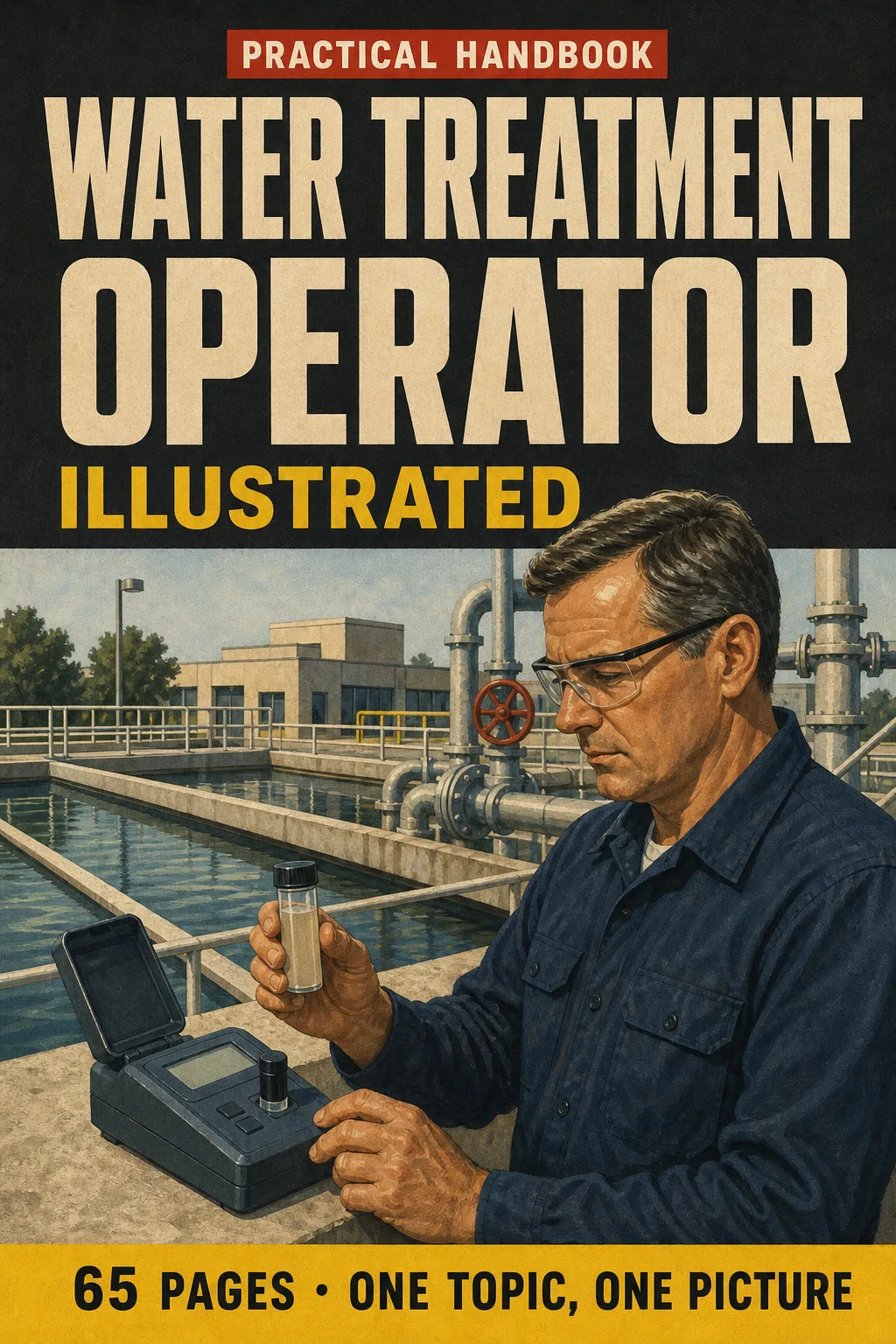
Coagulation, the jar test, filtration and backwash, chlorine and the breakpoint curve, CT, corrosion control and the pounds formula. Every topic gets its own page: the drawing first, then what you need to remember. 65 illustrated pages.

GET THE ILLUSTRATED BOOK

🔒 Secure checkout · PDF by email · 30-day guarantee

Every topic, its own pageEvery process and formula drawn, with the explanation beside it
65 illustrated pages9 parts, from the treatment train to the exam-day checklist
Up-to-date sourcesEPA drinking water rules (40 CFR 141), the SDWA and OSHA 29 CFR 1910
PDF by emailFormat

Look Inside the Book

Every page has one big drawing and a box with the numbers and steps you need to know:

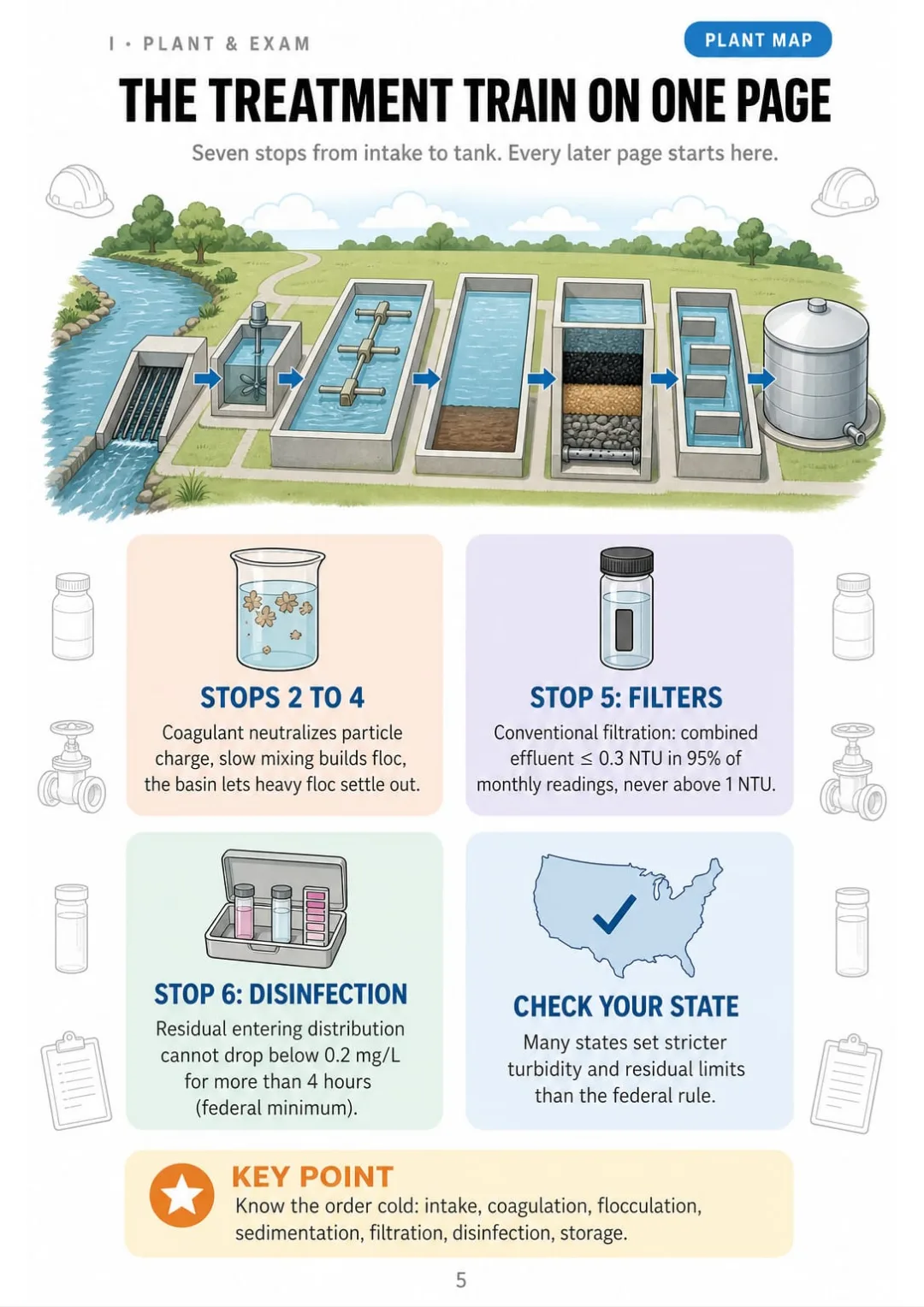
Intake to storage tank in 7 numbered stops, with the 0.3 NTU and 0.2 mg/L checkpoints.
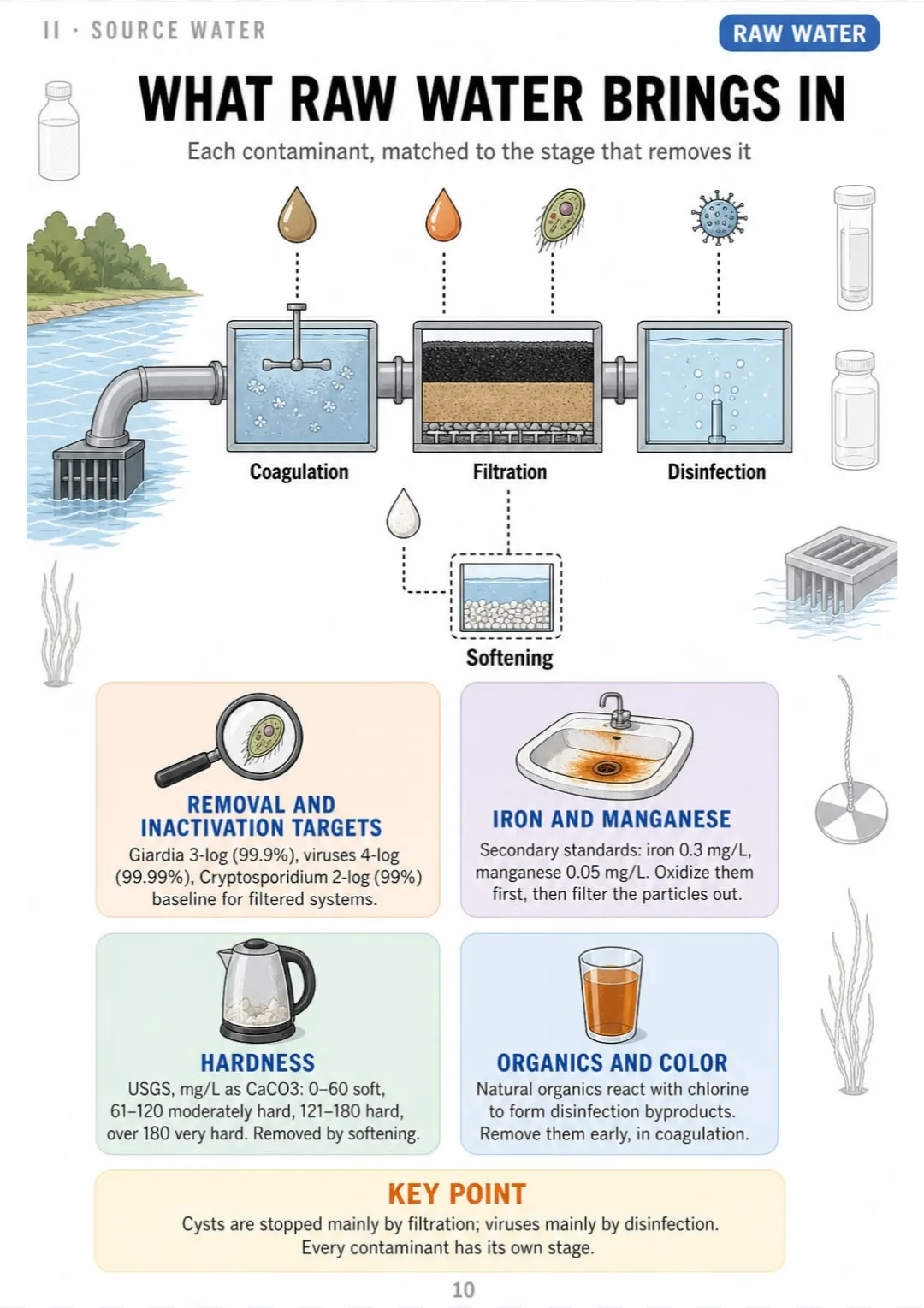
Turbidity, algae, Giardia, viruses, iron and manganese: who removes what, on one train.
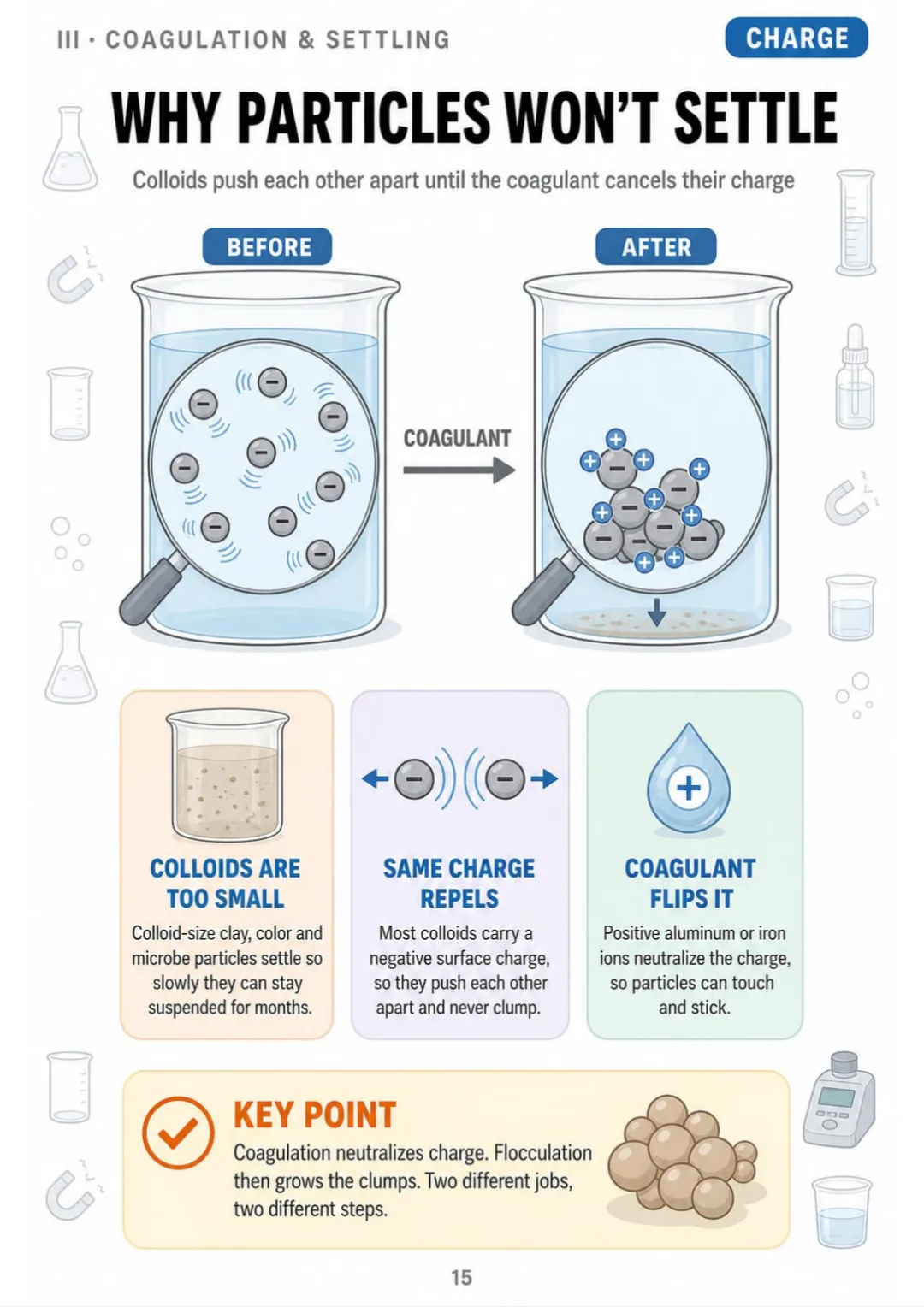
Negative colloids repel each other: the coagulant's positive ions let them stick
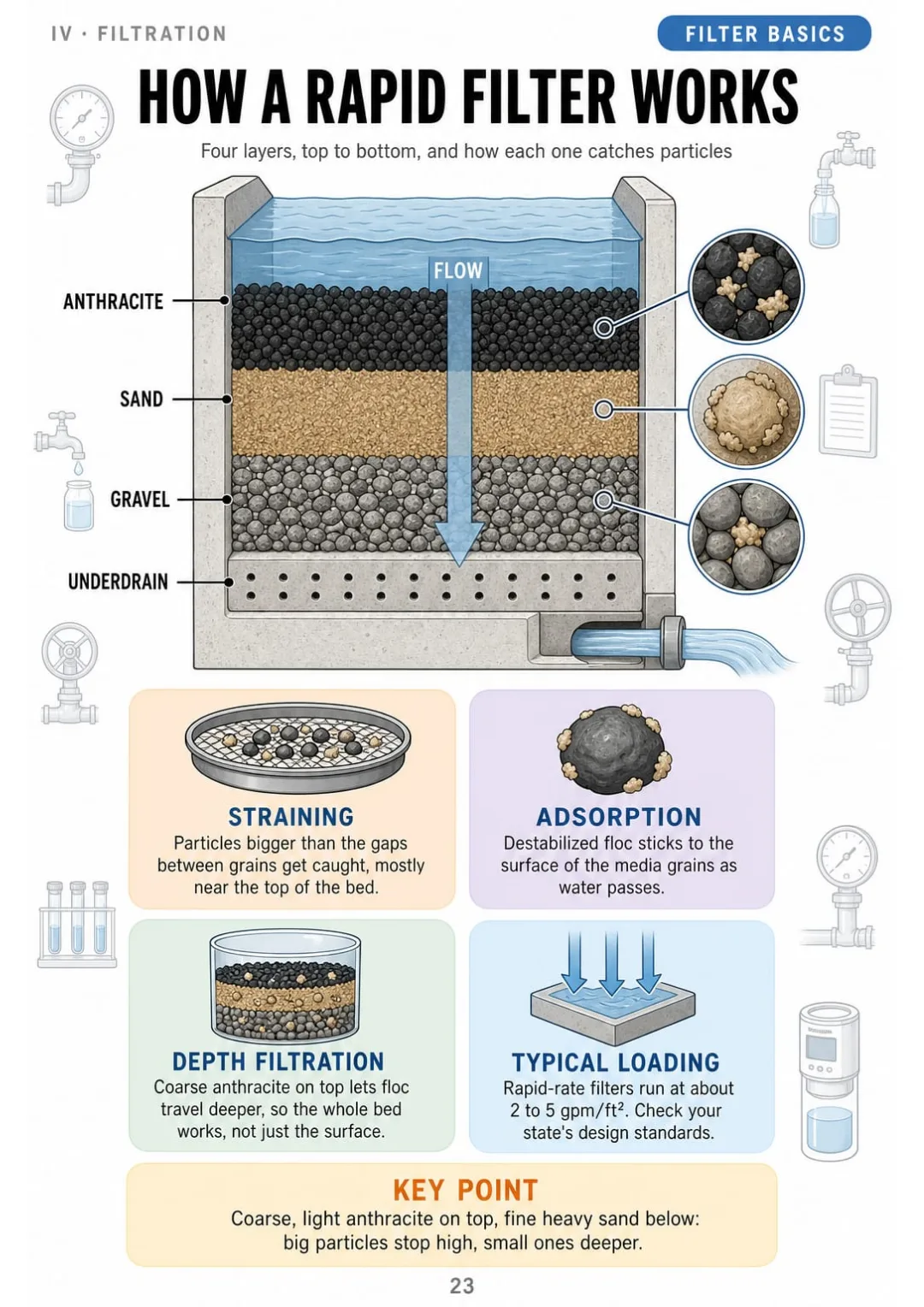
Anthracite over sand over gravel over underdrain, at about 2 to 5 gpm/ft².
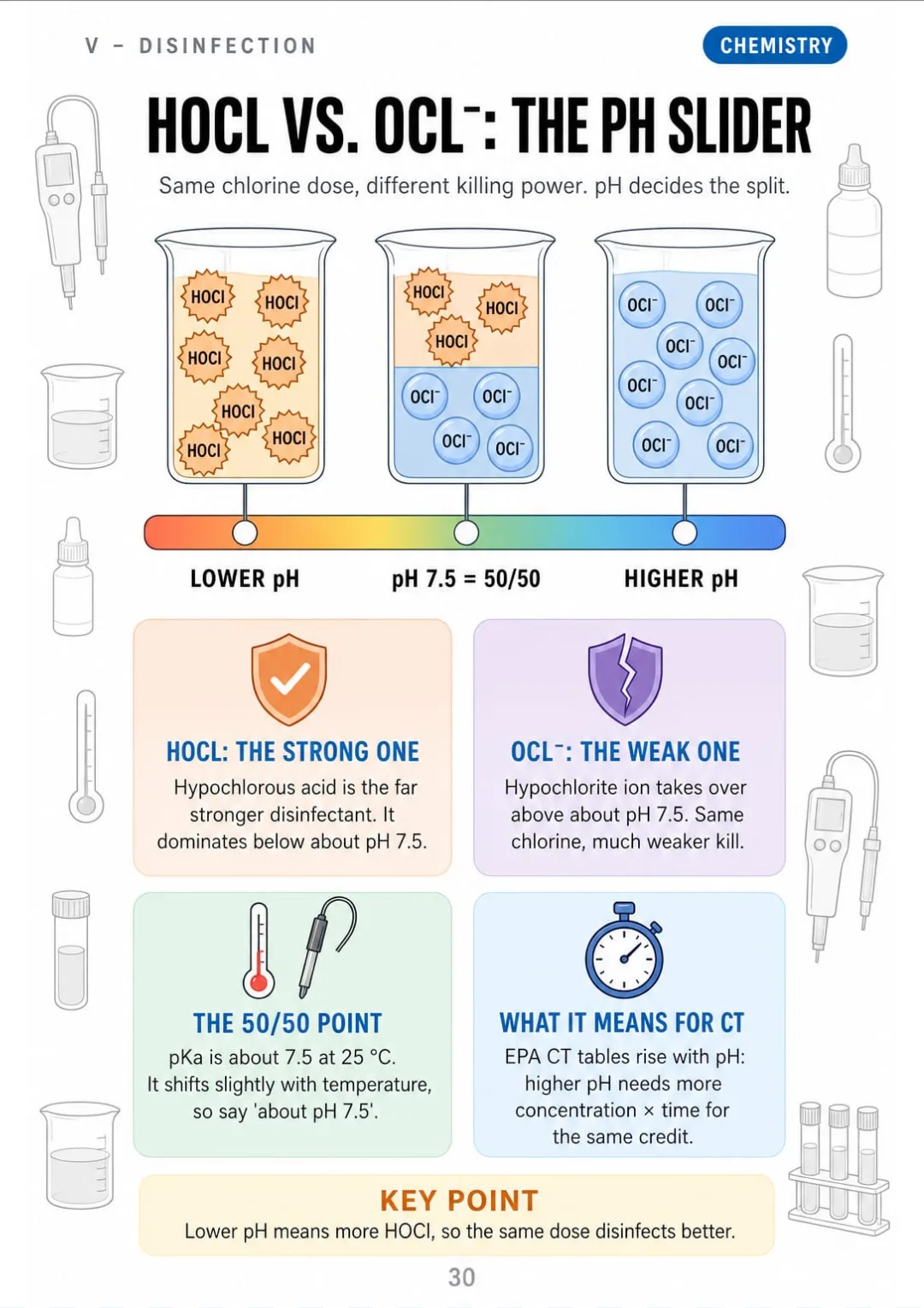
HOCl and OCl⁻ split about 50/50 near pH 7.5; lower pH means more HOCl.
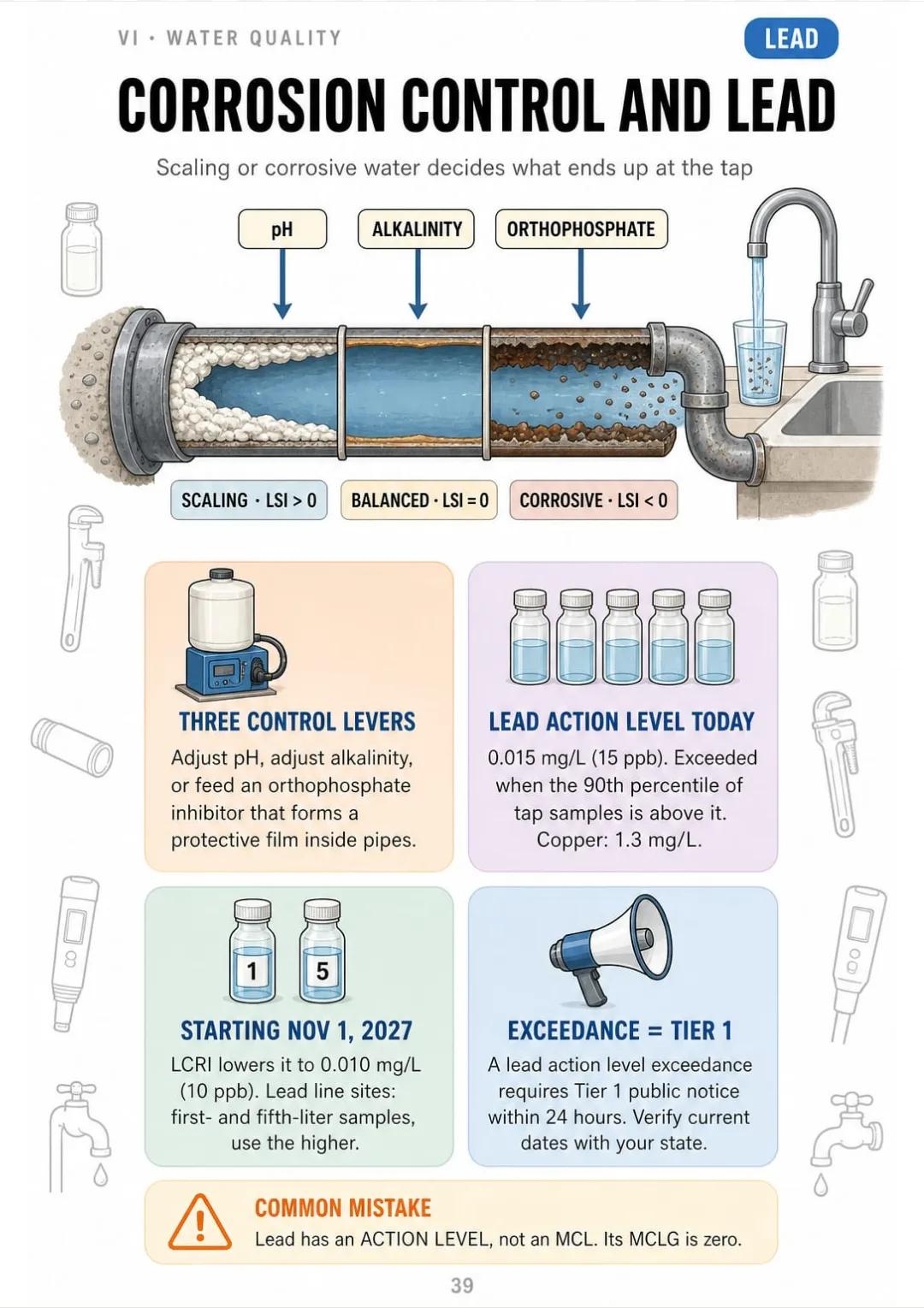
Lead action level: 0.015 mg/L today, 0.010 mg/L starting Nov 1, 2027 (LCRI)
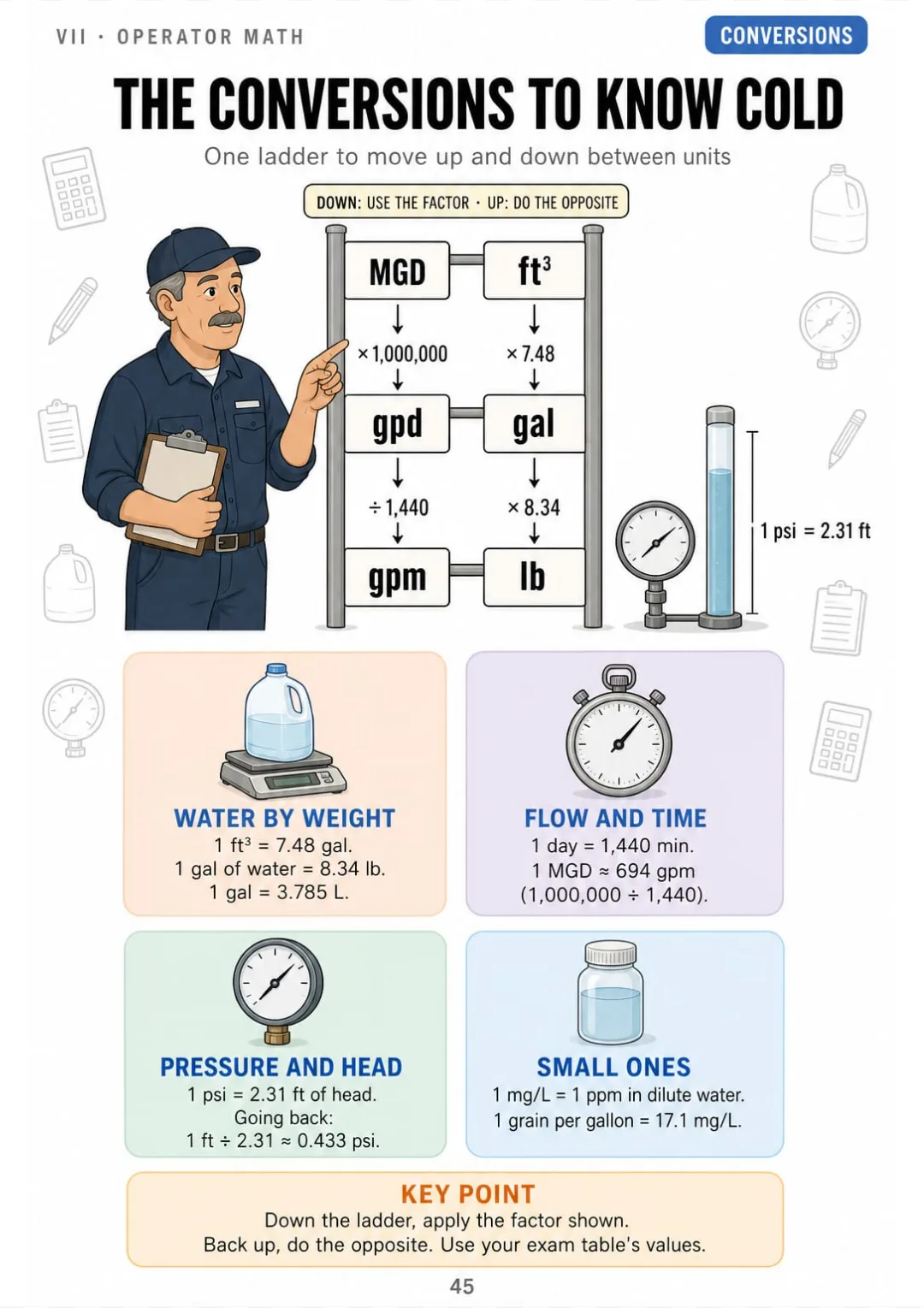
1 ft³ = 7.48 gal · 1 gal = 8.34 lb · 1 MGD ≈ 694 gpm · 1 psi = 2.31 ft
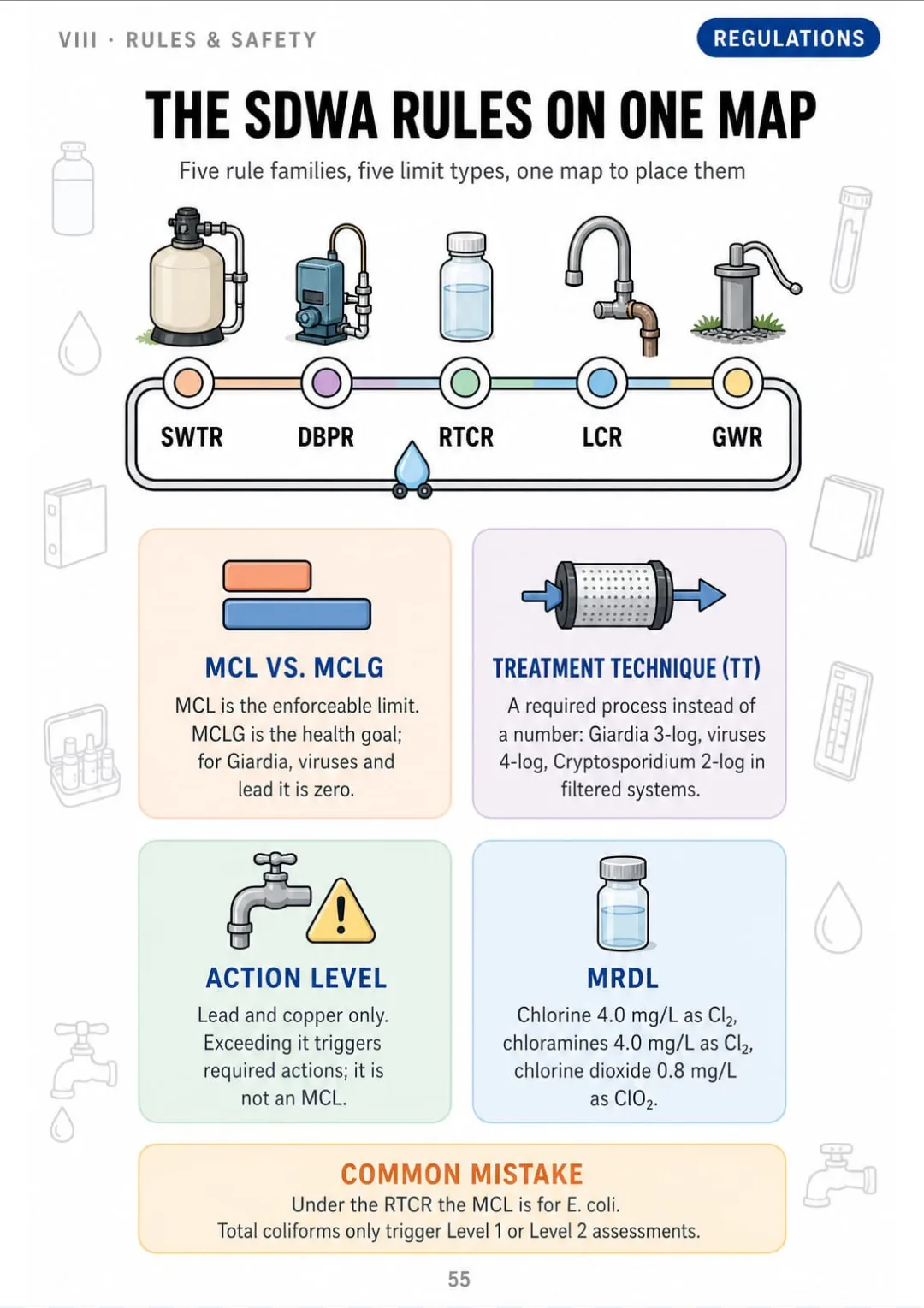
Chlorine and chloramine MRDL 4.0 mg/L, chlorine dioxide 0.8 mg/L, and the five rule families on one map

Swipe to see more →

These are real pages from the book. The table of contents is the full one: 9 parts and 61 topics.

The Problem Isn't You. It's How It Was Explained to You.

You're at the sed basin after a storm. The water coming out is still cloudy, and the supervisor asks you why the floc isn't forming.

You know the answer is somewhere in coagulation. But the manual covers colloids, surface charge and charge neutralization in three dense paragraphs, and none of it shows you what's happening in the water.

Negative colloids repel each other: the coagulant's positive ions let them stick

In the book, that's one page. Tiny particles drawn with minus signs, pushing each other away. Then the coagulant's positive ions land between them, and you watch them start to stick.

The same goes for the jar test, backwash, the breakpoint curve, CT and the pounds formula: each one has its own page.

You get it, and you can explain it right there at the basin, without going back to the manual.

COMPARE FOR YOURSELF

The Same Topic, Two Ways to Study It

THIS
  • The manual: line after line
  • Raw water contaminants explained only in words
  • You walk into the exam with doubts
Raw water quality is determined by source characteristics and by seasonal variability. Surface supplies typically present suspended particulate matter, measured as turbidity, together with algae, protozoan cysts such as Giardia lamblia and enteric viruses, whereas groundwater supplies more frequently contain dissolved iron and manganese in their reduced forms. The selection of treatment processes, including coagulation, filtration, oxidation and disinfection, must take into account the removal or inactivation mechanism applicable to each constituent, as well as the applicable regulatory requirements.
FOR THIS
  • Everything raw water brings in, in one drawing
  • Turbidity and Giardia → coagulation and filtration · Iron and manganese → oxidation
  • You see it and you get it
Turbidity, algae, Giardia, viruses, iron and manganese: who removes what, on one train.
CONTENTS

Take a Look at the 9 Parts and 61 Topics

The plant and the exam, source water and intake, coagulation to sedimentation, filtration, disinfection and chlorine chemistry, water quality, operator math, rules, lab and safety, and a final review: 65 pages, all illustrated

IThe Plant and the Exam · pp. 5-9
  1. The Treatment Train on One Page
  2. How State Operator Certification Works
  3. Surface Water vs. Groundwater Plants
  4. The Units Every Operator Uses
  5. The 3-Step Method for Every Math Problem
IISource Water and Intake · pp. 10-14
  1. What Raw Water Brings In
  2. Lake Turnover and Seasonal Changes
  3. Intake Structures and Screens
  4. Wells: Parts and Protection
  5. Pre-Treatment: Pre-Oxidation and Aeration
IIICoagulation, Flocculation, Sedimentation · pp. 15-22
  1. Why Particles Won't Settle on Their Own
  2. Coagulants: Alum, Ferric and Polymers
  3. Alkalinity and pH in Coagulation
  4. Rapid Mix
  5. Flocculation
  6. The Jar Test, Step by Step
  7. Sedimentation Basins
  8. Sludge Removal and Solids Handling
IVFiltration · pp. 23-29
  1. How a Rapid Filter Works
  2. Head Loss and the Filter Run
  3. Backwash Step by Step
  4. Filter Problems You Can See
  5. Turbidity Limits for Filtered Water
  6. Other Filters: Slow Sand, Pressure, Membranes
  7. Cryptosporidium and Log Removal
VDisinfection and Chlorine Chemistry · pp. 30-38
  1. Chlorine in Water: HOCl vs. OCl⁻
  2. Chlorine Demand, Dose and Residual
  3. Free vs. Combined Chlorine
  4. The Breakpoint Curve
  5. Chloramination
  6. CT: Concentration × Time
  7. Chlorine Forms: Gas, Hypo, Tablets
  8. Other Disinfectants: UV, Ozone, Chlorine Dioxide
  9. Disinfection Byproducts
VIWater Quality and Other Processes · pp. 39-44
  1. Corrosion Control and Lead
  2. Hardness and Softening
  3. Iron and Manganese
  4. Fluoridation
  5. Taste and Odor
  6. Storage Tanks and Distribution
VIIOperator Math, Worked Step by Step · pp. 45-54
  1. Conversions You Need Memorized
  2. Area and Volume of Tanks and Basins
  3. The Pounds Formula
  4. Pounds Formula with Hypochlorite
  5. Detention Time
  6. Filter Loading and Backwash Rate
  7. Surface Overflow and Weir Loading
  8. Percent Removal and Efficiency
  9. CT Calculation Worked
  10. Pumps, Pressure and Horsepower
VIIIRules, Lab and Safety · pp. 55-61
  1. The SDWA Rules on One Map
  2. Key MCLs to Know
  3. Sampling the Right Way
  4. Lab Tests at the Plant
  5. Chlorine Gas Safety
  6. Confined Spaces, Lockout and Chemicals
  7. Records, Reporting and Public Notice
IXFinal Review · pp. 62-65
  1. The Whole Plant in 7 Questions
  2. Formula Sheet in One Page
  3. Mix-Ups to Avoid
  4. Exam-Day Checklist

One Page, One Topic, All Clear

Think of it this way:

It's the night shift. The chlorine residual at the clearwell came in low, and you need to know how many pounds a day to feed before the supervisor asks.

You open the page on the pounds formula and there it is, drawn: MGD × mg/L × 8.34 = lbs/day, solved in the same 3 steps every time: what you know, which formula, units in and out.

HOCl and OCl⁻ split about 50/50 near pH 7.5; lower pH means more HOCl.

Same with the jar test, backwash, the breakpoint curve, CT and detention time: each one on its own page.

Water Treatment Operator Illustrated is 65 pages in 9 parts, every topic drawn, and the last part of the book closes with the whole plant in 7 review questions, a one-page formula sheet, the mix-ups to avoid and an exam-day checklist.

What you see drawn, you don't have to memorize.

What's Inside Water Treatment Operator Illustrated:

Ipp. 5-9

The Plant and the Exam

The treatment train on one page, how state certification works, surface water vs. groundwater plants, the units and the 3-step method for every math problem

IIpp. 10-14

Source Water and Intake

What raw water brings in, lake turnover, intakes and screens, wells and their protection, pre-oxidation and aeration

IIIpp. 15-22

Coagulation, Flocculation, Sedimentation

Why particles won't settle, alum, ferric and polymers, alkalinity and pH, rapid mix, flocculation, the jar test step by step, sedimentation basins and sludge: so you can read a jar test and explain why the floc isn't forming

IVpp. 23-29

Filtration

How a rapid filter works, head loss and the filter run, backwash step by step, filter problems you can see, turbidity limits, other filters and Cryptosporidium log removal

Vpp. 30-38

Disinfection and Chlorine Chemistry

HOCl vs. OCl⁻, demand, dose and residual, free vs. combined, the breakpoint curve, chloramination, CT, chlorine forms, UV, ozone, chlorine dioxide and byproducts

VIpp. 39-44

Water Quality and Other Processes

Corrosion control and lead, hardness and softening, iron and manganese, fluoridation, taste and odor, storage tanks and distribution

VIIpp. 45-54

Operator Math, Worked Step by Step

Conversions, tank volumes, the pounds formula with gas and hypochlorite, detention time, filter loading and backwash rate, overflow and weir loading, percent removal, CT and pump math: every problem in the same 3 steps, so you always know which number goes where

VIIIpp. 55-61

Rules, Lab and Safety

The SDWA rules on one map, key MCLs, sampling the right way, plant lab tests, chlorine gas safety, confined spaces and lockout, records and public notice

IXpp. 62-65

Final Review

The whole plant in 7 questions, a one-page formula sheet, mix-ups to avoid and an exam-day checklist

At the end of the book: The whole plant in 7 questions, a one-page formula sheet, the mix-ups to avoid and an exam-day checklist.
Plus: 2 Free Books

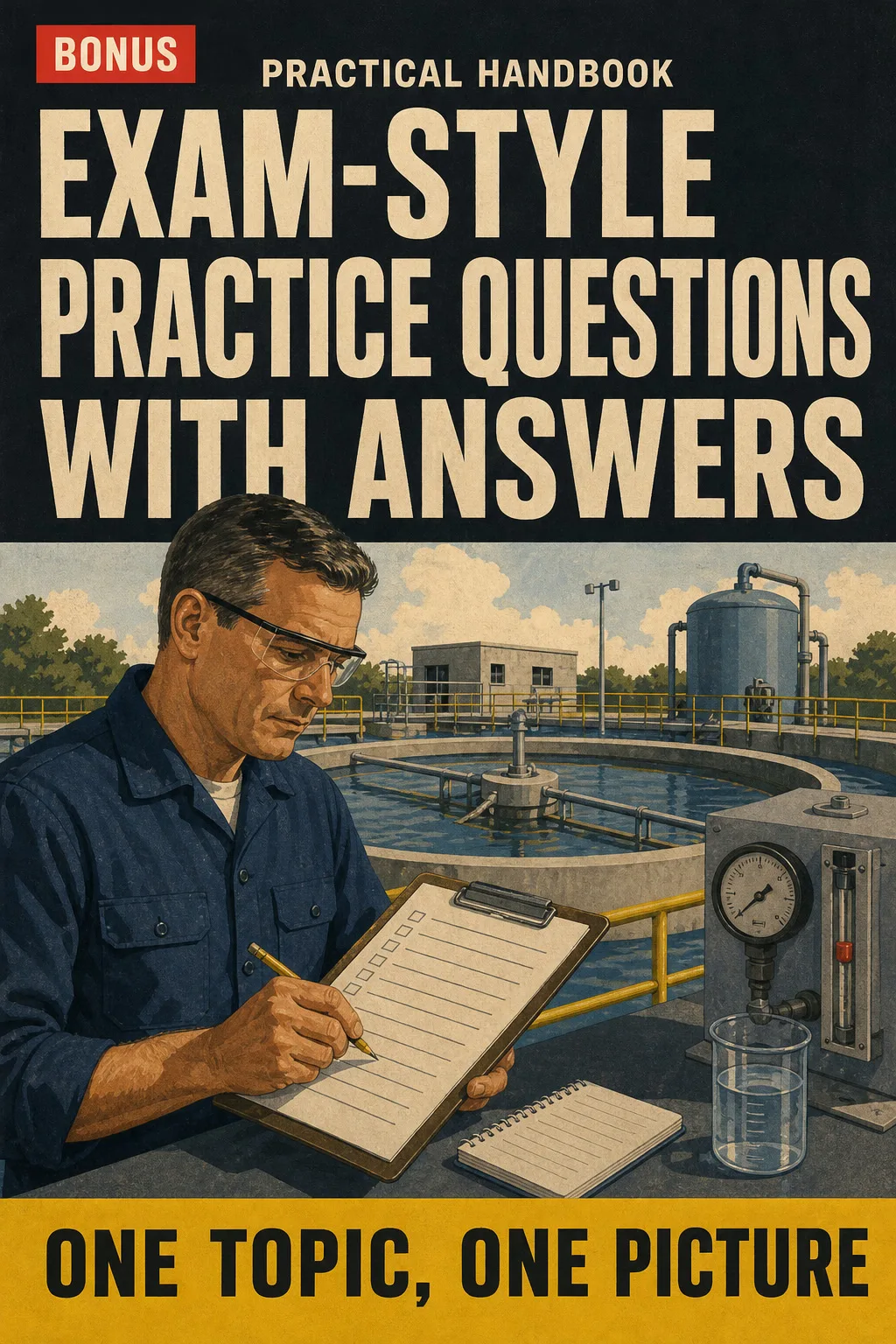
Exam-Style Practice Questions with Answers

BONUS 1: «Exam-Style Practice Questions with Answers»

Value on its own: US$ 17.90

Test yourself on every section of the book, and each answer points back to the page that explains it.

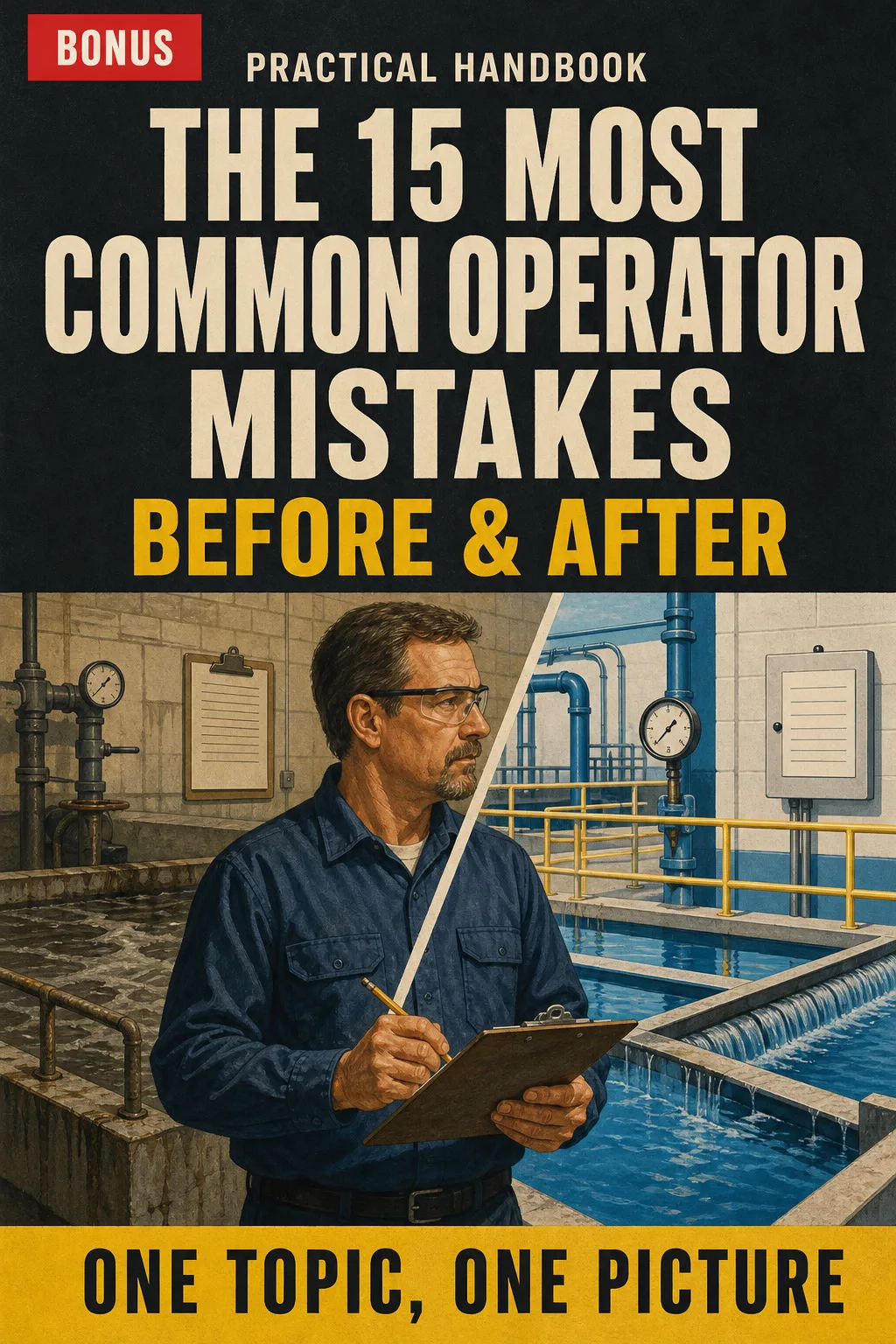
The 15 Most Common Operator Mistakes: Before & After

BONUS 2: «The 15 Most Common Operator Mistakes: Before & After»

Value on its own: US$ 14.90

See the mix-ups that trip up operators most often, like free vs. combined chlorine, mg/L vs. lbs/day and gpm vs. MGD, each drawn wrong and then right.

Water Treatment Operator Illustrated with 2 Free Books

  • Water Treatment Operator Illustrated: 65 illustrated pagesUS$ 63
  • BONUS 1: Exam-Style Practice Questions with AnswersUS$ 17.90
  • BONUS 2: The 15 Most Common Operator Mistakes: Before & AfterUS$ 14.90
  • High-resolution PDF to printIncluded
Total value US$ 95.80
YOUR PRICE:
US$ 27
You save US$ 68.80
YES, I WANT WATER TREATMENT OPERATOR ILLUSTRATED FOR US$ 27

📄 This is a digital PDF book sent to your email: nothing is printed or shipped.

Secure purchaseEncrypted payment30-day guarantee

PDF by email: We email you Water Treatment Operator Illustrated as a PDF, together with the two free books. It's a single payment: no installments, no extra charges.

Who This Book Is For

You're an operator-in-training

You're an operator-in-training

You see the whole plant in order, intake to storage tank, and learn where each term sits before you memorize a single one.

Your Grade exam is coming up

Your Grade exam is coming up

You review chlorine, CT and the operator math in the same 3 steps every time, then test yourself with the exam-style questions.

You already run the plant

You already run the plant

You keep the formulas, the conversions and the breakpoint curve printed and on hand, to check a reading or explain it to a new operator.

Everything You Get Today

US$ 95.80US$ 27
YES, I WANT WATER TREATMENT OPERATOR ILLUSTRATED FOR US$ 27

📄 This is a digital PDF book sent to your email: nothing is printed or shipped.

30DAYS
GUARANTEE

30-Day Guarantee

Try Water Treatment Operator Illustrated for 30 days, bonus books included.

We refund everything if the file won't open, if the book isn't what you see here, if you were charged twice or if the email doesn't arrive. Just email us.

You pay once. No subscriptions.

Frequently Asked Questions

Is it for me if I already work at the plant and I'm going for my next Grade?

Yes. It starts from the treatment train you already run and covers the core chemistry, math and rules that come up from entry level through the higher grades. States name their levels differently (Grade, Class, T1–T5, A–D) and set their own exams, so check your board's list of topics: the book covers the ground they share.

Where does the content come from?

From the U.S. EPA drinking water rules under the Safe Drinking Water Act (40 CFR Part 141), plus OSHA 29 CFR 1910 for safety. The numbers are the ones in force today. Where a rule is changing, like the lead action level going from 0.015 to 0.010 mg/L on Nov 1, 2027, the page shows both numbers and the date. Every regulatory number is marked so you can check it against your state's program, since states can be stricter.

Is this official material?

No. It's independent study material. It isn't issued or endorsed by the EPA, any state or any certification board, and it doesn't give you a certificate, CEUs or contact hours toward your license.

Does it replace my training course?

No. It doesn't replace your state's required training, your hours at the plant, OSHA safety training or your plant's procedures for chlorine cylinders and confined spaces. It's for studying and reviewing.

Are the practice questions the ones on the exam?

No. They're exam-style questions written for this book, and each answer points back to the page that explains it.

When and how do I get it?

The book and the 2 bonus books come as PDFs by email, to the address you enter at checkout.

Do I have to pay every month?

No. It's a one-time payment.

Can I have it on paper?

Yes. It's a PDF you can print, all of it or just the pages you need, and keep at the plant.

How does the refund work?

You have 30 days. We refund everything if the file won't open, if the book isn't what you see on this page, if you were charged twice or if the email doesn't arrive: just email us.

Before You Close This Page

No more rereading and having nothing stick.

The breakpoint curve: you see it drawn, and that's it.

You walk into the exam knowing where everything sits in the plant.

Drawings make studying faster.

The book is right below.

One-time payment: US$ 27 · Guarantee: 30 days · PDF by email

YES, I WANT WATER TREATMENT OPERATOR ILLUSTRATED FOR US$ 27

📄 This is a digital PDF book sent to your email: nothing is printed or shipped.